2. Methods
MSD’s electrochemiluminescence detection technology uses SULFO-TAG labels that emit light upon electrochemical stimulation initiated at the electrode surfaces of MULTI-ARRAY and MULTI-SPOT microplates. The MSD S-PLEX Neurology Panel 1 is a three-analyte ultrasensitive panel. The S-PLEX platform uses ECL technology, retaining its well-known advantages and superior analytical performance. The improved sensitivity of S-PLEX assays is due to the proprietary TURBO-TAG and TURBO-BOOST reagents.
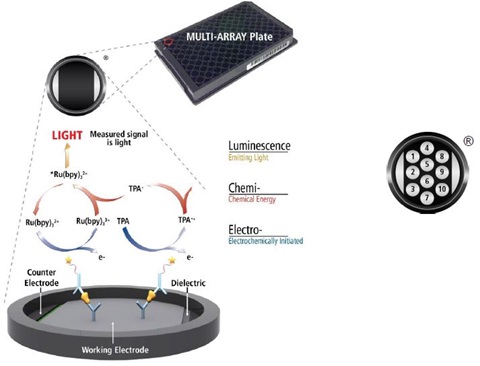
Electrochemiluminescence Technology
- Minimal non-specific background and strong responses to analyte yield high signal-to-background ratios.
- The stimulation mechanism (electricity) is decoupled from the response (light signal), minimizing matrix interference.
- Only labels bound near the electrode surface are excited, enabling non-washed assays.
-
Labels are stable, non-radioactive, and directly conjugated to biological molecules.
-
Emission at ~620 nm eliminates problems with color quenching.
-
Multiple rounds of label excitation and emission enhance light levels and improve sensitivity.
- Carbon electrode surface has 10X greater binding capacity than polystyrene wells.
- Surface coatings can be customized.

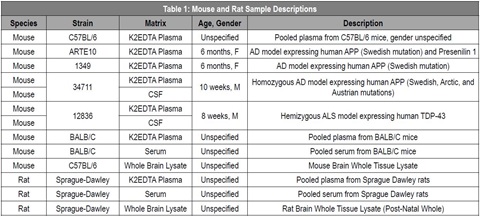
3. Tested Samples
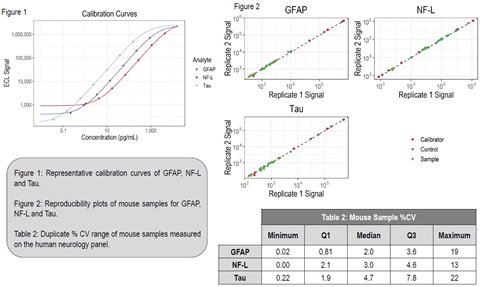
4. Assay Performance and Reproducibility
5. Rodent Native Analyte Recognition and Dilution Linearity
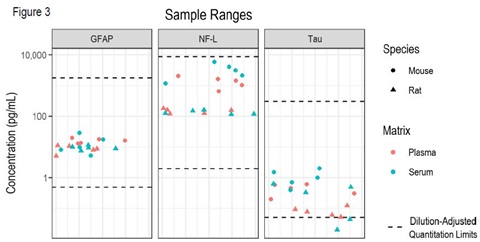
Normal BALB/C mouse and normal Sprague Dawley rat serum and plasma (n=5 each) samples were all detectable in the human GFAP and NF-L assays, and all but two samples were within the limits of quantitation in the human Tau assay (Figure 3).
Figure 3: Concentration ranges of normal mouse and rat serum and plasma samples. Dashed lines are dilution-adjusted (2-fold) quantitation limits.
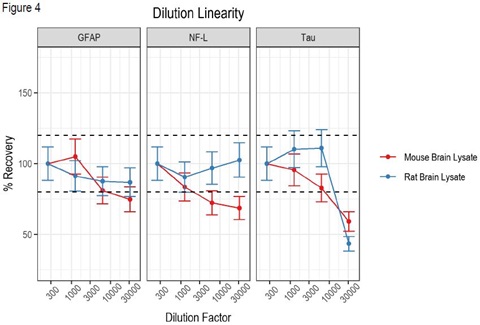
Normal mouse and rat whole brain lysates were tested for dilution linearity and cross-reactivity. With an initial total protein concentration of 1mg/mL, the starting dilution factor was 250-fold with further serial dilutions to 31,250-fold. The recommended dilution is 250-fold to 1000-fold in whole brain lysate, which here is the equivalent of 1 – 4 μg/mL of total protein (Figure 4).
Normal mouse and rat serum and plasma were tested at 2-fold and 5-fold dilutions (data not shown). All analytes were detectable and diluted linearly in mouse serum and plasma and in rat serum. GFAP and NF-L were detectable and diluted linearly in rat plasma, while Tau was only detectable in rat plasma at 2-fold dilution. The recommended dilution for mouse and rat serum and plasma is 2-fold, aligning with the human serum and plasma recommendation for this assay.
Figure 4: Dilution linearity of whole brain lysate. Error bars are 95% CI. Dashed lines indicate±20% from reference sample at 250-fold dilution.
6. Elevated Neurology Biomarkers in Mouse Models of Neurodegeneration
Plasma from four different mouse models of Alzheimer’s disease (AD) and one model of amyotrophic lateral sclerosis (ALS) were tested alongside C57BL/6 (control) commercially sourced mouse plasma at the recommended 2-fold dilution. Cerebrospinal fluid (CSF) samples matched from one model of AD and the model of ALS were tested at 100-fold dilution only due to limited sample availability. The biomarkers in all plasma samples were within the quantifiable range. The AD CSF samples were thresholded to assay limits of quantitation for GFAP and Tau, but detectable for NF-L. The ALS CSF samples showed elevated levels of all three analytes compared to levels in the AD model, though none showed significance due to high variability and the small number of samples that were tested. All plasma analytes trended higher in all ND models compared to normal mice, and measurements in the ALS model were further elevated above the AD model. AD plasma levels were significantly higher for GFAP and NF-L compared to controls.
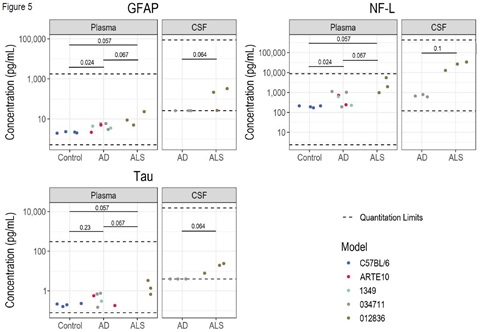
Figure 5: Plasma and CSF concentrations from control and ND mouse models. P-values calculated between differences of means by Wilcoxon test. Dashed lines indicate dilution-adjusted quantitation limits.
7. Matched Plasma and CSF Correlations in Mice
Levels of GFAP, NF-L and Tau in matched plasma and CSF from an AD mouse model (n=3) and an ALS mouse model (n=3) were highly correlated, indicating mouse plasma is a sufficient matrix for detecting biomarkers of neurodegeneration in these models. This is consistent with literature on matched human CSF and plasma levels of GFAP, NF-L and Tau.
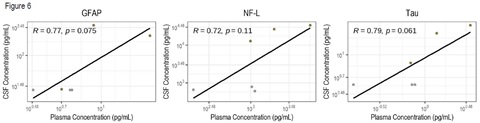
Figure 6: Matched plasma and CSF from ND mouse models correlated between 0.72-0.79 Pearson’s coefficient across all three analytes.
8. Conclusions
The MSD Human S-PLEX Neurology Panel 1 effectively cross-reacts with mouse and rat samples. GFAP and NF-L are fully detectable in mouse and rat serum, plasma, brain lysate, and CSF, and tau is detectable at a 2-fold dilution for serum and plasma and in 0.16 μg/mL of total brain lysate protein. Neurodegenerative mouse models display measurable increases in all analytes, varying based on the particular model. The humanized TDP-43 mouse model of ALS expresses particularly high levels of GFAP, NF-L and Tau compared to all tested AD mouse models. Levels in matched plasma and CSF samples from ND mouse models correlate well for all three analytes. These data demonstrate that the MSD Human S-PLEX Neurology Panel 1 can be used to quantify GFAP, NF-L, and Tau in various rodent models for research, model development, and biomarker development studies.